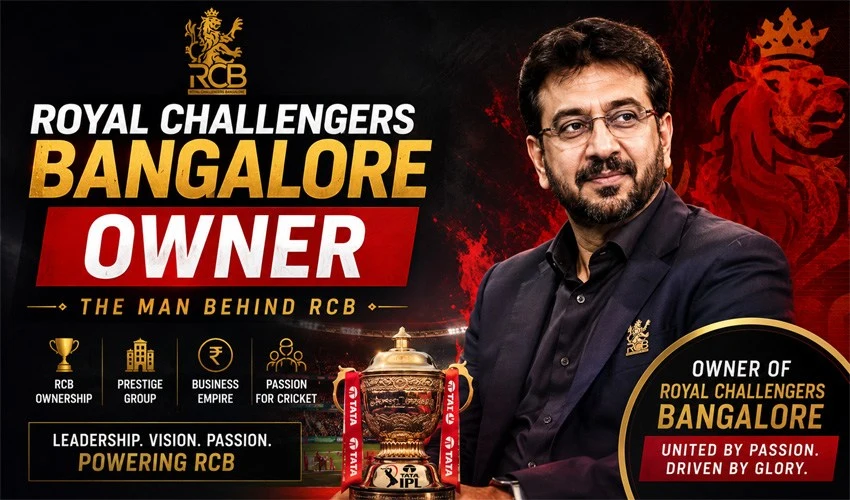
Royal Challengers Bengaluru, long known by cricket fans simply as RCB, is one of the most recognizable and emotionally charged franchises in the Indian Premier League. For years, the team’s ownership story was relatively simple: a liquor conglomerate backing a cricket brand that shared its name with a whisky label. But 2026 has turned that story upside down. A blockbuster ownership change, one of the largest transactions in global sports history, has reshaped who actually owns RCB, how much the franchise is worth, and what business empire now sits behind the team’s red and black jersey. This article walks through the full picture: the current owner, the ownership history, the franchise’s staggering valuation, and the corporate empire now steering RCB’s future.
Who Owns RCB Now?
For most of RCB’s existence, the franchise was owned by United Spirits Limited (USL), India’s largest liquor company, which itself operated as a subsidiary of the British multinational beverage giant Diageo. That changed dramatically in March 2026, when United Spirits finalized the sale of its entire equity stake in Royal Challengers Sports Private Limited, the legal entity that owns and operates RCB’s IPL and WPL franchises, to a four-member consortium. The buying group includes the Aditya Birla Group, one of India’s oldest and largest business conglomerates; The Times of India Group, India’s dominant media conglomerate with deep roots in cricket coverage and sports media; Bolt Ventures, the private investment vehicle of American sports investor David Blitzer, who holds ownership stakes across major leagues including the NBA, NFL, NHL, MLB, and English Premier League; and Blackstone, through its perpetual private equity strategy known as BXPE, one of the largest alternative asset managers in the world.
This deal marked the complete exit of Diageo and United Spirits from cricket ownership, closing a chapter that had defined RCB’s corporate identity since 2016. The transaction was valued at approximately $1.78 billion, or roughly ₹16,660 crore, making it the most expensive cricket franchise sale in history at the time it closed, surpassing an earlier 2026 record set by the sale of Rajasthan Royals.
So, in short: as of 2026, Royal Challengers Bengaluru is owned by a consortium led jointly by the Aditya Birla Group, The Times of India Group, Bolt Ventures, and Blackstone, rather than by any single individual owner.
A Brief History of RCB’s Ownership
To understand how significant this change is, it helps to trace RCB’s ownership journey from the beginning. The franchise was established in 2008, the inaugural year of the IPL, when liquor baron Vijay Mallya, through his United Breweries Group, purchased the Bangalore-based franchise for approximately $111.6 million. At the time, this was among the highest prices paid for any IPL franchise, reflecting Mallya’s ambition to build a marquee team around the country’s cricket-obsessed south.
The team’s name, Royal Challengers, was chosen deliberately to promote United Spirits’ flagship whisky brand of the same name, a branding strategy that shaped the franchise’s identity for years, even as IPL regulations restricted direct alcohol advertising during broadcasts. Mallya remained a visible, colorful presence around the team for years, but his fortunes shifted dramatically as his business empire ran into serious financial and legal trouble. In 2016, Mallya resigned as Chairman of United Spirits, and Diageo, which had earlier acquired a controlling stake in United Spirits back in 2012, assumed full operational and management control of the franchise.
For roughly the next decade, RCB operated under Diageo’s ownership through United Spirits, a period during which the franchise built a passionate global fanbase, expanded into the Women’s Premier League by acquiring the Bengaluru WPL franchise for ₹901 crore in 2023, and eventually broke a long title drought by winning its first-ever IPL championship in 2025, followed by a successful title defense in 2026 that made RCB just the third franchise in IPL history to win back-to-back trophies.
It was against this backdrop of on-field success and rising commercial value that Diageo, under pressure to streamline its global portfolio and focus on its core alcoholic beverages business, launched a formal sale process for RCB in late 2025 and early 2026, ultimately concluding with the record-breaking consortium deal.
RCB’s Valuation and Net Worth
Franchise valuations in the IPL have grown at a staggering pace since the league’s founding, and RCB’s trajectory captures that growth vividly. Various brand valuation reports placed RCB’s worth at around $269 million in early 2026, reflecting its brand strength, enormous fan following, and consistent presence among the league’s most valuable and recognizable teams even before the ownership sale was finalized.
However, the ownership sale itself revealed a far higher figure for what buyers were actually willing to pay for full control of the franchise. The $1.78 billion transaction price encompassed not just the men’s IPL team but the entire commercial ecosystem built around the RCB brand: the RCB Women’s WPL franchise, all associated brand intellectual property, the RCB Bar & Café hospitality venture, and the RCB Unbox entertainment and content properties. This comprehensive scope explains why the transaction value dwarfs simpler brand valuation estimates, since it reflects the full commercial machine behind the team rather than just the playing squad’s market value.
This sale price places RCB among the most valuable franchises in global sport, not just cricket, underscoring how dramatically IPL franchise economics have shifted since Mallya’s original $111.6 million purchase less than two decades earlier.
The Business Empire Behind RCB Today
With Diageo’s exit, RCB is now backed by four distinct but complementary business powerhouses, each bringing a different kind of strength to the franchise’s future.
The Aditya Birla Group is one of India’s largest and most diversified conglomerates, with a business history spanning more than 165 years and operations across more than 40 countries. Its portfolio includes cement, metals, telecommunications, financial services, retail, and a wide range of consumer-facing brands, giving RCB access to deep corporate relationships, strong governance frameworks, and an extensive domestic retail and brand-building footprint.
The Times of India Group brings a different but equally valuable asset: media reach. As one of India’s largest media conglomerates, the group operates Cricbuzz, widely regarded as the world’s leading cricket digital platform, along with Willow TV, the primary home of cricket broadcasting in North America. The group also holds ownership interests in Major League Cricket in the United States and the London Spirit franchise in England’s Hundred competition, positioning it to help RCB expand its reach into international cricket markets and fan engagement platforms.
Bolt Ventures, the investment arm of David Blitzer, adds a rare cross-league sports ownership perspective. Blitzer is known as one of the most prolific sports investors in the world, holding ownership stakes across the NBA, NFL, NHL, MLB, MLS, and the English Premier League, among other leagues on multiple continents. His involvement brings experience in modern sports franchise operations, fan monetization strategies, and global sports business trends that extend well beyond cricket.
Finally, Blackstone, through its BXPE strategy, contributes financial scale and institutional investment discipline. As the world’s largest alternative asset manager, overseeing well over a trillion dollars in assets globally, Blackstone’s involvement signals significant confidence in the long-term commercial trajectory of Indian cricket and the IPL as an investable asset class.
Together, this consortium represents a shift in Indian sports ownership toward diversified, professionally managed investment groups, rather than single-industry corporate parents or individual promoters, a trend also visible in the nearly simultaneous sale of Rajasthan Royals earlier in 2026.
What This Means for RCB’s Future
For fans, the immediate on-field product is unlikely to change dramatically in the short term, since the consortium acquired an already successful, back-to-back championship-winning setup. But the broader implications of this ownership change are significant. With media, retail, global sports investment, and private equity expertise all represented at the ownership table, RCB is positioned to expand well beyond its traditional identity as an IPL cricket team. Areas like international fan engagement, hospitality ventures such as the RCB Bar & Café chain, digital content through RCB Unbox, and deeper integration with global sports business practices are all likely growth avenues under the new ownership structure.
Conclusion
Royal Challengers Bengaluru’s ownership story has moved through three distinct eras: the flamboyant, individually-led Vijay Mallya period, the decade-long corporate stability of Diageo and United Spirits, and now, as of 2026, a consortium-led model bringing together Indian conglomerate strength, media reach, global sports investment experience, and private equity capital. With a transaction value of $1.78 billion, RCB now stands as one of the most valuable franchises in world sport, backed by an ownership group with the scale and diversity to shape its next chapter both on and off the field.

More Stories
Sunrisers Hyderabad vs Royal Challengers Bengaluru Timeline (2013–2026)
Kolkata Knight Riders vs Lucknow Super Giants Match Scorecard: A Super Over Thriller for the Ages
India National Cricket Team vs Pakistan National Cricket Team Standings: Complete Head-to-Head Analysis