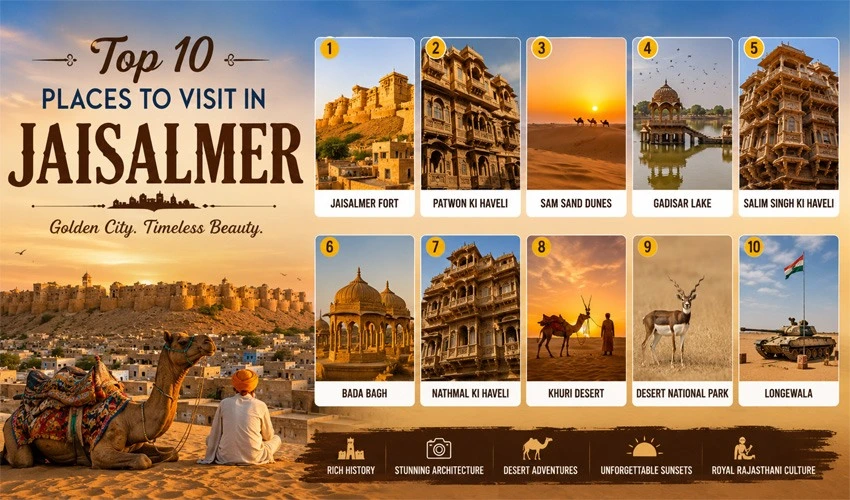
Rising out of the Thar Desert like a mirage carved in honey-colored sandstone, Jaisalmer is one of Rajasthan’s most enchanting destinations. Known as the “Golden City,” this former trading post on the ancient Silk Route still hums with the spirit of camel caravans, merchant princes, and desert warriors. Every wall, haveli, and temple here seems to glow at sunset, giving the entire city a warm, storybook quality that few places in India can match.
Whether you’re a history buff, a photography enthusiast, or someone chasing the thrill of a desert safari under a blanket of stars, Jaisalmer has something extraordinary waiting for you. Here are the top 10 places you simply cannot miss on your visit to this desert jewel.
1. Jaisalmer Fort (Sonar Quila)
No trip to Jaisalmer is complete without exploring its crown jewel — the Jaisalmer Fort, also called Sonar Quila or the “Golden Fort.” Built in 1156 AD by the Rajput ruler Rawal Jaisal, this massive fort stands on Trikuta Hill and is one of the very few “living forts” in the world, meaning thousands of people still reside within its walls.
As you wander through its narrow lanes, you’ll find centuries-old havelis, temples, shops selling handicrafts, and cozy guesthouses, all coexisting within the fortress. The fort’s ramparts offer breathtaking panoramic views of the city, especially magical during sunrise and sunset when the sandstone truly earns its golden reputation. Don’t miss the intricately carved palace complex inside, which now functions as a museum showcasing royal artifacts, weapons, and manuscripts.
2. Patwon Ki Haveli
Just a short walk from the fort lies Patwon Ki Haveli, arguably the most elaborate cluster of havelis in Jaisalmer. This isn’t a single building but a complex of five havelis built by wealthy Jain merchants in the 19th century. The facade is a masterclass in stone carving, featuring delicate latticework, ornate balconies, and intricately designed doorways.
The interiors are equally impressive, with mirror work, frescoes, and painted ceilings that reflect the opulence of the merchant families who once lived here. One section has been converted into a small museum where you can view period furniture, textiles, and artifacts that offer a glimpse into Jaisalmer’s mercantile past. Photographers particularly love this spot for its symmetry and golden-hour lighting.
3. Sam Sand Dunes
For most travelers, the Sam Sand Dunes are the highlight of any Jaisalmer itinerary. Located about 40 kilometers from the city, this stretch of the Thar Desert offers the quintessential desert experience — rolling golden dunes as far as the eye can see. Camel safaris are the most popular way to explore the dunes, with rides typically timed around sunset when the sky turns brilliant shades of orange and pink.
Beyond camel rides, the area has become a hub for desert camping, with many resorts offering tented accommodations complete with cultural performances featuring traditional Rajasthani music and dance. Dune bashing in 4×4 jeeps is another popular activity for thrill-seekers. Spending a night here under an unpolluted, star-studded sky is an experience that stays with travelers long after they leave.
4. Bada Bagh
Bada Bagh, meaning “Big Garden,” is a serene complex of royal cenotaphs located about 6 kilometers north of Jaisalmer. This site was built as a memorial garden for the rulers of Jaisalmer, and today it houses beautifully carved chhatris (domed cenotaphs) dedicated to various Maharawals of the region.
What makes Bada Bagh particularly striking is its setting — the cenotaphs sit atop a hill overlooking a valley dotted with wind turbines, creating a fascinating contrast between ancient architecture and modern renewable energy infrastructure. The site is especially popular at sunset, when the golden domes are silhouetted against the sky, making it a favorite spot among photographers and history enthusiasts alike.
5. Gadisar Lake
Gadisar Lake is a tranquil, artificial lake originally built in the 14th century by Maharawal Gadsi Singh to serve as the primary water source for the city. Surrounded by numerous small temples, shrines, and ghats, the lake exudes a peaceful charm that contrasts beautifully with the arid desert landscape surrounding it.
Visitors can enjoy a leisurely boat ride on the lake, especially delightful during early morning or evening hours when the temperature is cooler and the light is soft. The impressive Tilon ki Pol gateway that leads to the lake is worth admiring for its architectural detail. During winter, the lake also attracts migratory birds, making it a nice spot for casual birdwatching.
6. Kuldhara Village
For those interested in mystery and folklore, Kuldhara is an abandoned village located around 18 kilometers from Jaisalmer. Legend has it that this once-thriving Paliwal Brahmin settlement was mysteriously deserted overnight in the early 19th century, and locals believe the village is cursed and haunted to this day.
Whether or not you believe in the supernatural stories, Kuldhara offers a hauntingly beautiful glimpse into a bygone era. The ruins of homes, temples, and streets remain remarkably intact, frozen in time. Walking through the crumbling structures as the desert wind howls around you creates an eerie yet fascinating atmosphere that history and mystery lovers will thoroughly enjoy.
7. Nathmal Ki Haveli
Another architectural gem in Jaisalmer’s collection of havelis, Nathmal Ki Haveli was built in the late 19th century and once served as the residence of the city’s prime minister. What makes this haveli particularly interesting is that it was constructed by two brothers who worked on either side of the building simultaneously without much coordination — resulting in a structure that is almost, but not quite, symmetrical.
The haveli’s yellow sandstone facade is adorned with detailed carvings depicting elephants, soldiers, and floral motifs. Some carvings even include quirky details like a bicycle and a fan, added by the sculptors as a personal touch. The interior features beautiful paintings and remains partially inhabited by the descendants of the original family, adding a lived-in authenticity to the experience.
8. Desert Cultural Centre and Museum
If you want to understand the history, traditions, and culture of Jaisalmer and the surrounding Thar Desert region, the Desert Cultural Centre and Museum is an excellent stop. This modest but informative museum showcases artifacts, textiles, musical instruments, and photographs related to the region’s Rajput heritage and desert lifestyle.
The museum also hosts a puppet show in the evenings, a traditional Rajasthani art form known as “Kathputli,” which is both entertaining and educational. It’s a great activity for families and anyone wanting a deeper cultural context before exploring the rest of the city.
9. Khaba Fort and Village
Located near Kuldhara, Khaba Fort is a lesser-known but equally captivating site. This ruined hilltop fort once served as a lookout post for the surrounding Paliwal villages. Today, part of the fort has been converted into a small museum displaying fossils, pottery, and artifacts from the region.
The nearby Khaba village, much like Kuldhara, was abandoned and now lies in ruins, offering visitors a quieter, less crowded alternative to explore similar historical remnants. The rooftop of the fort provides sweeping views of the desert landscape, making it a great spot to appreciate the vastness of the Thar.
10. Jain Temples Inside Jaisalmer Fort
Within the walls of Jaisalmer Fort lies a stunning complex of interconnected Jain temples dating back to the 12th and 15th centuries. Dedicated to various Tirthankaras, these temples are renowned for their exceptionally intricate yellow sandstone carvings, which rival even the finest temple architecture found in Rajasthan.
The temple complex includes seven main shrines connected via detailed corridors and doorways, each showcasing masterful stone artistry. Unlike much of Rajasthan’s Jain heritage which uses white marble, these temples uniquely utilize the golden sandstone native to Jaisalmer, giving them a distinct visual character. Visitors should dress modestly and check timings in advance, as the temples have specific visiting hours separate from the general fort access.
Planning Your Jaisalmer Trip
Jaisalmer is best visited between October and March, when the desert climate is pleasant and comfortable for sightseeing and outdoor activities like camel safaris and dune camping. Summers can be extremely harsh, with temperatures soaring well above 40°C, making it less ideal for extensive exploration.
Most of the attractions listed above can be comfortably covered in a 2-3 day itinerary, though desert lovers may want to extend their stay to enjoy an overnight camping experience at Sam Sand Dunes. Local transportation options include auto-rickshaws, taxis, and rented bikes, though many of the in-city attractions like the fort, havelis, and Gadisar Lake are within walking distance of each other in the old city.
Final Thoughts
Jaisalmer isn’t just a destination — it’s an experience that transports you to a different era, where merchant princes built golden mansions, warriors defended hilltop fortresses, and the desert wind still whispers stories of villages lost to time. From the living heritage of Jaisalmer Fort to the tranquil beauty of Gadisar Lake and the vast, star-lit dunes of Sam, this city offers a rare blend of history, mystery, culture, and natural beauty.
Whether you have two days or a full week, make sure these 10 destinations are on your Jaisalmer itinerary. Each one tells a different chapter of the Golden City’s remarkable story, and together, they create memories that will last a lifetime.


More Stories
How to Plan the Perfect Goa Getaway with a Private Vacation Home
15 Best Places to Visit in Chikmagalur for an Unforgettable Trip
25 Best Places to Visit in Dehradun for Nature and Adventure Lovers