Introduction: When Two Giants Collide
There are rivalries in cricket, and then there is Royal Challengers Bengaluru versus Kolkata Knight Riders. Since the very first ball of the Indian Premier League was bowled in April 2008, these two franchises have been involved in a clash of cultures, cricketing philosophies, and passionate fan bases that stretches across nearly two decades. One side represents the electric energy of Bengaluru — a city fuelled by ambition and colour. The other carries the legacy of Kolkata — proud, passionate, and steeped in cricketing tradition. Together, they have produced one of the most layered and entertaining rivalries in T20 cricket history.
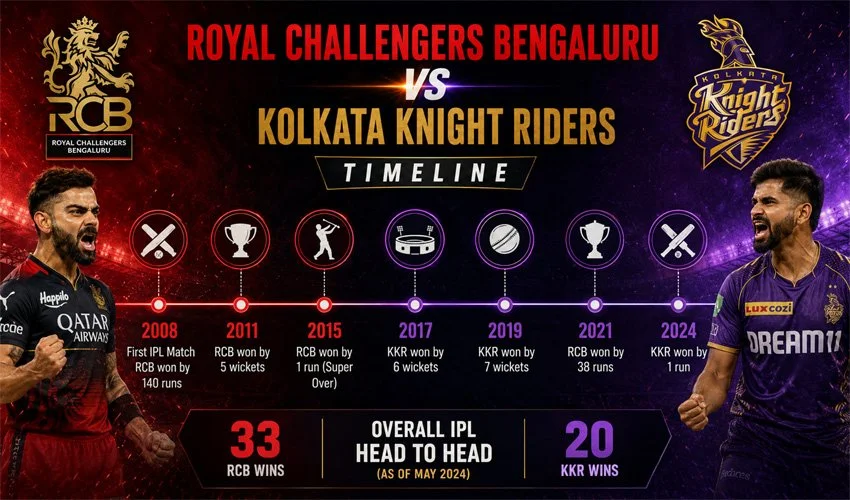
Over 37 matches spread across 18 IPL seasons, this contest has delivered everything: record-breaking individual innings, catastrophic collapses, last-ball thrillers, dominant victories, and moments so dramatic they have become part of IPL folklore. This article traces the full RCB vs KKR timeline — season by season — to capture how this rivalry has grown, shifted, and continued to captivate millions.
2008: Where It All Began — The Night McCullum Rewrote History
The Royal Challengers Bengaluru vs Kolkata Knight Riders rivalry was born on April 18, 2008 — not just as a match, but as the opening game of IPL history itself. At the M. Chinnaswamy Stadium in Bengaluru, a sold-out crowd barely knew what to expect from this new format. What they witnessed was nothing short of a revolution.
New Zealand opener Brendon McCullum walked to the crease for KKR and proceeded to dismantle the RCB bowling attack in a manner no one had seen in India before. He scored an unbeaten 158 off just 73 balls — an innings that established the tone for everything the IPL would become: explosive, unscripted, and utterly breathtaking. KKR won comfortably, and the rivalry was off to a seismic start.
The two sides met again later that season, with KKR again asserting themselves. Those early encounters established KKR as the more dominant force in this particular head-to-head, a pattern that would define the rivalry for several years.
2009–2011: RCB Fights Back — The Gayle Storm Begins
The 2009 IPL, held in South Africa due to election-related scheduling conflicts in India, saw a shift in fortunes. RCB swept both encounters against KKR, winning first in Durban by five wickets and then at Centurion by six. These victories signalled that RCB, rebuilding their squad with sharper intent, were not content playing second fiddle.
By 2011, the arrival of Chris Gayle at RCB changed everything. In a first-round match at Eden Gardens, Gayle produced a whirlwind performance that handed RCB a nine-wicket win. The Universe Boss, as he would come to be known, had found his IPL home — and KKR would bear the brunt of his brilliance on multiple occasions. RCB won both encounters in 2011, demonstrating that the tide had genuinely turned.
These three seasons established a compelling truth about this rivalry: it would never remain one-sided for long. Every time one team built dominance, the other found a way to respond.
Also Read: Lucknow Super Giants vs Royal Challengers Bengaluru Timeline
2012–2014: KKR’s Trophy Years — A New Era of Discipline
The 2012 IPL was transformational for KKR. Under Gautam Gambhir’s calm and authoritative captaincy, and bolstered by the arrival of Sunil Narine — a mystery spinner from Trinidad who would go on to define an era — KKR became a more complete, balanced unit. They won their first IPL title that year, defeating Chennai Super Kings in the final.
In their encounters against RCB that season, Gambhir led from the front with a commanding 93 off 51 balls in one game, while Narine’s bowling began to expose RCB’s over-reliance on power hitting. KKR won both matches, and the superiority of their system over RCB’s star-studded but inconsistent lineup was evident.
KKR went on to win their second IPL title in 2014, defeating Kings XI Punjab. These trophy years cemented KKR’s reputation as tournament builders — a franchise that performed when it mattered. For RCB, despite having Virat Kohli, AB de Villiers, and Chris Gayle in the same lineup, translating individual brilliance into collective triumph remained elusive.
2015–2016: High Scores and Kohli at His Peak
The middle period of the rivalry produced some of the highest-scoring matches in IPL history. With flat pitches, small boundaries, and batting line-ups stacked with match-winners on both sides, scores in excess of 200 became almost routine.
Virat Kohli entered his peak T20 years during this phase. Against KKR, he was at his imperious best — accumulating runs at will, converting starts into match-defining innings, and carrying RCB’s batting on his shoulders when others failed. His record against KKR began its extraordinary accumulation, which would eventually cross 1,000 runs — making him the highest run-scorer in this specific rivalry.
The 2016 season, in which RCB came agonisingly close to winning their maiden IPL title before losing in the final, highlighted both the promise and the heartbreak that would come to define their story. Their wins over KKR that year were among their best performances of the campaign — a reminder that when RCB’s batting unit clicked, they were capable of overwhelming anyone.
2017: RCB’s Darkest Hour — 49 All Out
If the 2008 McCullum innings was the rivalry’s most spectacular high, then the events of 2017 represent its most jarring low — at least from RCB’s perspective.
In a match at Eden Gardens, Royal Challengers Bengaluru were bowled out for just 49 runs — the lowest team score in IPL history. The KKR pace attack, led by Nathan Coulter-Nile and supported by Colin de Grandhomme and Chris Woakes, ripped through the RCB batting lineup without mercy. Not a single RCB batter reached double figures. The carnage was complete.
Remarkably, in a second encounter that season, KKR dominated again through the sheer brilliance of Sunil Narine, who posted what was then the fastest IPL fifty (50 off 15 balls). That game underlined how comprehensively KKR had figured out RCB in those years — outbowling and out-batting them with alarming ease.
2018–2020: IPL in Transition — Bio-Bubbles and Changing Fortunes
The 2018 and 2019 seasons were transitional for both sides. In 2019, Kohli and AB de Villiers produced a masterclass together — Kohli smashing 84 off 49 and de Villiers contributing 63 off 32 — to propel RCB to 205/3. KKR came close but ultimately fell short, with RCB winning by 10 runs. Kohli was Player of the Match and was later confirmed to have scored his fifth IPL century in that game — a mark of just how consistently he raised his game against this particular opponent.
The COVID-affected 2020 season, played in the UAE, compressed the schedule and altered playing conditions. Both teams were finding their footing in near-empty stadiums. The rivalry’s competitive heartbeat continued, but the absence of crowd noise and home comforts changed the texture of the games.
2021: Sunil Narine Breaks RCB Hearts in the Playoffs
The 2021 season provided a rare three-match chapter in this rivalry — two league games and a playoff encounter. RCB won the first league match convincingly with AB de Villiers in masterful form. However, in the second league game, Varun Chakravarthy ran through RCB’s batting to hand KKR a nine-wicket win.
The decisive encounter came in the Eliminator at Sharjah. RCB posted a competitive 138/7, but Sunil Narine — batting, this time — smashed three consecutive sixes to take the game away from Bengaluru. His 4/21 with the ball had already kept RCB from posting a bigger total. KKR won by four wickets, eliminating RCB from the tournament. It was another reminder that in knockout cricket, this rivalry produced its most dramatic chapters.
2022–2023: KKR’s Spin Web Tightens
The 2023 season saw KKR reach near-total dominance over RCB in their head-to-head encounters. Their spin triumvirate of Narine, Varun Chakravarthy, and young Suyash Sharma combined to take nine wickets between them in one encounter, bowling RCB out for a modest 123 at Eden Gardens. It was a masterclass in reading opposition weaknesses and executing a plan under pressure.
KKR swept RCB in both meetings in 2023 and continued into 2024, racking up four consecutive wins over Bengaluru — their longest winning run in this specific rivalry. The strategic deployment of spin, particularly against RCB’s aggressive batting style, had become KKR’s signature weapon.
2024: The 443-Run Thriller — A Classic for the Ages
If any single match encapsulates the drama and grandeur of this rivalry, it is the April 2024 encounter at Eden Gardens. KKR posted an astonishing 222/6, with Phil Salt blasting 48 off just 14 balls to set a breathtaking tempo at the top. RCB responded with one of the greatest chases in T20 history — reaching 221/10 off the final ball, falling agonisingly short by a single run.
The match aggregate of 443 runs became the highest in the history of this rivalry and one of the most watched T20 games ever played. KKR won by one run, and the cricket world struggled to absorb what it had just witnessed.
KKR completed a season sweep in 2024 and then went on to win the IPL title — their third championship. For RCB, so near yet so far in that Eden Gardens epic, it was another instalment in their complicated romance with IPL glory.
2025–2026: RCB’s Resurgence and Kohli’s Coronation
The tables turned dramatically in IPL 2025. RCB — rebranded, refreshed, and deeply motivated — dismantled KKR in the season opener, restricting them to 175 and chasing it down with seven wickets and 22 balls to spare. Krunal Pandya’s three-wicket haul in the middle overs was the turning point, demonstrating that RCB had finally built a bowling unit capable of supporting their celebrated batting.
In 2026, the rivalry produced another unforgettable chapter. After a rain delay in Raipur, with KKR posting 192/4 on the back of Angkrish Raghuvanshi’s polished 71, Virat Kohli — fresh off two consecutive ducks — walked out and produced a knock of rare elegance and authority. His unbeaten 105 off 60 balls, including his ninth IPL century, guided RCB home by six wickets with five balls remaining. It was not just a match-winning innings; it was a statement of continued genius. RCB moved to the top of the IPL 2026 points table, and Kohli’s century against KKR added yet another chapter to a rivalry that has been threaded with his brilliance for nearly two decades.
Also Read: Top 50 Interesting Facts About Cricket
The Numbers That Define a Rivalry
The head-to-head record currently stands at KKR 20, RCB 15, with one match producing no result — across 36 completed or near-completed encounters. Virat Kohli leads all scorers in this fixture with 1,021 runs across 32 innings at a strike rate of 133.63, including seven half-centuries and that landmark century in 2026. For KKR, Gautam Gambhir’s 647 runs remain the gold standard among former players, while Sunil Narine’s 17-plus wickets and countless match-turning batting contributions have made him the most dangerous all-round threat in this contest.
The highest individual innings is still McCullum’s historic 158* in 2008. The lowest team score is RCB’s catastrophic 49 in 2017. The highest match aggregate is the 2024 Eden Gardens one-run thriller’s 443 combined runs.
Conclusion: A Rivalry Built to Last
The Royal Challengers Bengaluru vs Kolkata Knight Riders timeline is more than a log of cricket results. It is a living document of contrasts — Bengaluru’s flair against Kolkata’s structure, individual genius against collective discipline, heartbreaking near-misses against composed championship wins. From McCullum’s thunderbolt in 2008 to Kohli’s century in 2026, each chapter has added something new to an already rich narrative.
With RCB currently flying high as defending champions in IPL 2026 and KKR’s young brigade firing on all cylinders, the rivalry shows no sign of becoming predictable or predictable. Every time these two sides meet, the history of their contests hangs in the air — and somehow, every new encounter finds a way to add to it.
For cricket lovers, this is not just a match on a fixture list. It is an institution. And it is far from finished.



More Stories
Royal Challengers Bangalore Owner Name, Net Worth & Business Empire
Sunrisers Hyderabad vs Royal Challengers Bengaluru Timeline (2013–2026)
Kolkata Knight Riders vs Lucknow Super Giants Match Scorecard: A Super Over Thriller for the Ages